How Does AI Use Water? Data Centers, Cooling and the Real Numbers
Artificial intelligence uses water because AI depends on physical infrastructure. The servers running AI models generate heat, some data-center cooling systems use or evaporate water to remove that heat, electricity production can have its own water footprint, and manufacturing advanced…

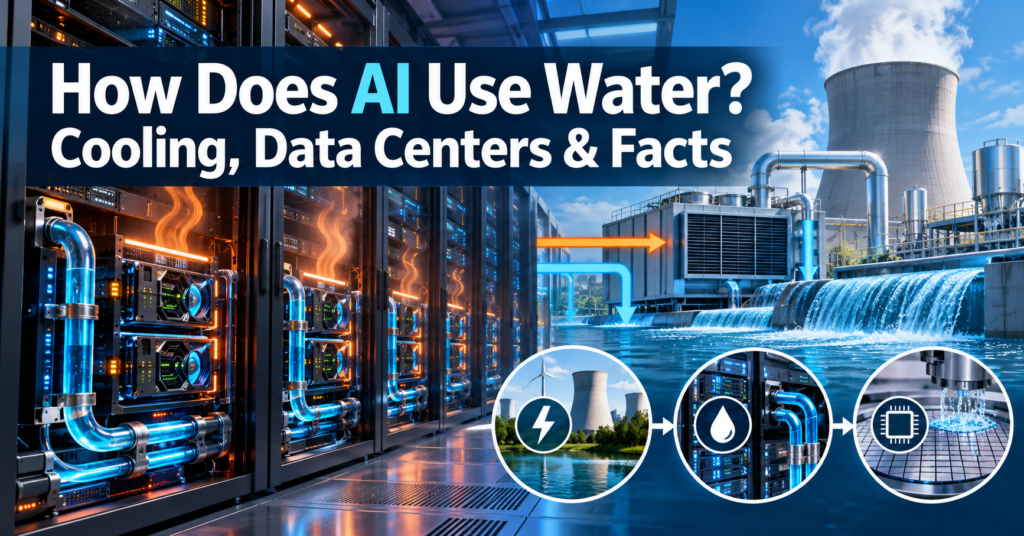
Artificial intelligence uses water because AI depends on physical infrastructure. The servers running AI models generate heat, some data-center cooling systems use or evaporate water to remove that heat, electricity production can have its own water footprint, and manufacturing advanced semiconductors requires highly purified water.
The important point is that an AI prompt does not literally cause a server to “drink” a glass of water. Instead, each workload can be assigned a share of a much larger infrastructure footprint. There is also no universal number of milliliters of water per AI prompt because the result changes with the model, hardware, location, cooling system, electricity supply, weather, and accounting method.
How Does AI Use Water?
AI uses water through three main pathways: data-center cooling, electricity generation, and manufacturing the chips and hardware that run AI systems. Some cooling systems consume water through evaporation, power plants may use water while generating electricity, and semiconductor factories need ultrapure water for wafer processing. The amount attributable to one AI request varies widely and cannot be represented by one universal figure.
AI Water Use at a Glance
| Stage | Why water is used | Direct or indirect? | Usually included in per-prompt estimates? |
|---|---|---|---|
| Data-center cooling | Removing heat from servers | Direct | Sometimes |
| Electricity generation | Cooling and thermal power processes | Indirect | Sometimes |
| Chip manufacturing | Producing ultrapure water and cleaning wafers | Supply chain | Usually not |
| Server manufacturing | Component and equipment production | Supply chain | Usually not |
| Facility construction | Construction materials and site operations | Supply chain | Rarely |
This distinction matters because two studies can report very different “water per prompt” figures while both are describing legitimate but different accounting boundaries.
Why AI Servers Need Cooling
AI models run on physical computing equipment, including GPUs, AI accelerators, CPUs, memory, storage, and networking hardware.
When those systems perform calculations, electrical energy ultimately becomes heat. Dense AI servers can produce large amounts of heat in a relatively small rack area, and that heat must be continuously removed to prevent processors from overheating, slowing down, or failing.
The mathematical AI model itself does not consume water. Water becomes relevant through the infrastructure used to move heat away from computing equipment and reject that heat outside the data center.
How Water Cools an AI Data Center
A simplified heat-removal chain looks like this:
AI workload → processor generates heat → air or liquid carries the heat away → facility cooling equipment rejects the heat → some systems evaporate water
Data centers can use several cooling technologies.
Chilled-water systems circulate cold water through equipment that absorbs heat.
Cooling towers can reject heat by evaporating part of the water into the atmosphere.
Evaporative cooling uses the cooling effect created when water evaporates.
Direct-to-chip liquid cooling circulates coolant near processors, making it particularly useful for high-density AI hardware.
Immersion cooling places computing equipment or components in a dielectric liquid that carries away heat.
Dry or air cooling rejects heat mainly through air and can greatly reduce direct water consumption.
A crucial distinction is that liquid cooling does not automatically mean high water consumption. Coolant may circulate repeatedly through a sealed system. What determines water consumption is largely how the collected heat is ultimately rejected.
Microsoft, for example, announced a new data-center design introduced beginning in August 2024 that uses closed-loop chip-level cooling and consumes zero water for cooling through evaporation. Microsoft estimates the design can avoid more than 125 million liters of cooling water per data center each year. That does not mean the entire facility or its supply chain has zero water footprint.
Water Circulation Is Not the Same as Water Consumption
Large quantities of liquid can circulate through cooling infrastructure without being permanently lost.
Recirculated water may repeatedly absorb and transport heat.
Water consumption generally refers to water that is no longer immediately available to the same local water environment, commonly because it has evaporated.
This is why saying that millions of liters “flow through” a cooling system does not necessarily mean millions of liters are consumed.
Water Withdrawal vs. Water Consumption
Two terms are especially important when evaluating AI water claims.
Water withdrawal is water taken from a river, reservoir, groundwater source, utility, or other supply.
Water consumption is the portion that is not promptly returned to the same local water environment, often because it evaporates.
Imagine a facility withdraws 1,000 liters and later returns 850 liters to the local system. Its withdrawal and consumption are not the same quantity.
Both metrics matter. Withdrawal can affect local infrastructure and ecosystems, while consumption can reduce the water immediately available for other users.
Any AI water statistic should therefore make clear which one it measures.
AI Also Uses Water Through Electricity
Cooling is only part of the operational water footprint.
Some power plants use water for steam production, condenser cooling, and other thermal processes. Consequently, the electricity powering an AI server can create an indirect or offsite water footprint.
How much depends on factors including:
- electricity source;
- power-plant cooling technology;
- regional grid mix;
- climate;
- and location.
This creates an important trade-off. A data center using very little water onsite may still have water consumption associated with its electricity supply.
Conversely, replacing evaporative cooling with dry cooling can reduce onsite water consumption but may require additional electricity under certain conditions.
That is why water, electricity, carbon emissions, climate, and local resource availability should be evaluated together rather than assuming one cooling technology is environmentally superior everywhere.
How Chip Manufacturing Adds to AI’s Water Footprint
AI also depends on GPUs, accelerators, CPUs, memory, and networking equipment produced in semiconductor fabrication plants.
Semiconductor manufacturing uses water extensively because wafers must be cleaned repeatedly during fabrication. Tiny particles, minerals, ions, or organic contaminants can interfere with processes occurring at microscopic scales.
Manufacturers therefore produce ultrapure water, or UPW, for wafer cleaning and other manufacturing operations.
TSMC’s sustainability reporting shows how important water is to semiconductor production. Its 2024 product water-footprint assessment found that the wafer-manufacturing stage represented 85% of the reported water-consumption indicator, while raw-material suppliers accounted for the remainder. TSMC has also introduced reclaimed water into ultrapure-water systems used in advanced manufacturing processes after extensive qualification.
Intel likewise identifies water conservation and restoration as significant components of its semiconductor-manufacturing sustainability program.
These figures should not be converted into a supposedly exact “liters per AI GPU” number without a detailed, product-specific life-cycle assessment.
What Is Ultrapure Water?
Ultrapure water is water treated to remove extremely small quantities of minerals, ions, particles, organic compounds, and other contaminants.
Chipmakers need this level of purity because microscopic contamination can interfere with semiconductor fabrication.
After use, manufacturers can treat, reclaim, or reuse some process water. The proportion varies by facility, process, and water-management system.
Training vs. Inference: Which Uses More Water?
Training is the computational process used to create or update an AI model.
Inference happens when someone uses the trained model—for example, by submitting a prompt and receiving an answer.
A single large training run can require substantial computing resources. However, it is misleading to conclude that training always dominates a model’s lifetime environmental footprint.
A popular service may perform billions of inference requests after training. Over its operating life, those requests can accumulate a large resource footprint.
The balance depends on:
- model size;
- number of training and fine-tuning runs;
- lifetime usage;
- hardware efficiency;
- response length;
- data-center location;
- cooling technology;
- and electricity supply.
How Much Water Does One AI Prompt Use?
There is no universal per-prompt water figure.
Three widely discussed estimates demonstrate why.
| Source | System | Reported figure | Type | Major limitation |
|---|---|---|---|---|
| Google, 2025 | Median Gemini Apps text prompt | 0.26 mL | Point-in-time provider measurement/modeling methodology | Specific to Gemini Apps and Google’s defined measurement boundary |
| Sam Altman, 2025 | Average ChatGPT query | 0.000085 U.S. gallons ≈ 0.32 mL | Provider-reported average | Full technical methodology was not publicly detailed |
| Li et al., 2025 CACM | GPT-3 scenarios | 500 mL per roughly 10–50 medium-length responses | Academic modeling | GPT-3-era infrastructure and scenario-specific assumptions |
Google reported that a median Gemini Apps text prompt during its measurement period used approximately 0.24 Wh of energy, produced 0.03 g CO2e, and consumed 0.26 mL of water. Google explicitly presented this as a measurement of its Gemini serving environment rather than a universal AI value.
Sam Altman separately stated that an average ChatGPT query uses approximately 0.000085 U.S. gallons of water, equivalent to roughly 0.32 mL. His public statement did not provide a detailed methodology specifying the exact model distribution, locations, direct-versus-indirect boundary, or measurement period, so it is best treated as a provider-reported average rather than a complete life-cycle assessment.
These figures should not be averaged together.
Does ChatGPT Really Use a Bottle of Water Per Question?
No credible research establishes that every ordinary AI question consumes a 500 mL bottle of water.
The frequently repeated claim traces to research by Pengfei Li, Jianyi Yang, Mohammad A. Islam, and Shaolei Ren.
The peer-reviewed 2025 Communications of the ACM version of “Making AI Less ‘Thirsty’” says that, under its modeled GPT-3 scenarios, approximately one 500 mL bottle could correspond to roughly 10–50 medium-length responses, depending on when and where inference occurred.
That is very different from saying one question consumes one bottle.
It is also a GPT-3-era modeled estimate and should not automatically be assigned to current ChatGPT, Gemini, Claude, or other AI services.
How Much Water Was Estimated for Training GPT-3?
The same peer-reviewed study estimated that training the 175-billion-parameter GPT-3 model in Microsoft’s U.S. data centers could involve approximately 5.4 million liters of total water consumption under its methodology.
Of that total, approximately 700,000 liters represented estimated onsite, or scope-1, water consumption.
The wording matters: these are researchers’ modeled estimates, not meter readings showing that GPT-3 used exactly 5.4 million liters.
The results depend on assumed infrastructure, electricity, location, energy use, and water-intensity factors.
Why Do AI Water Estimates Differ So Much?
Different estimates can vary by orders of magnitude because researchers and providers may be measuring different things.
Important variables include:
- AI model;
- prompt length;
- output length;
- reasoning or computation required;
- hardware generation;
- hardware utilization;
- batching efficiency;
- data-center cooling system;
- temperature and humidity;
- data-center location;
- electricity-grid mix;
- water source;
- whether electricity-related water is included;
- whether training is included;
- whether chip manufacturing is included;
- measured versus modeled data;
- median versus average values;
- and whether the unit represents a prompt, response, conversation, or user session.
Without these details, comparing two per-prompt numbers can be misleading.
What Is Water Usage Effectiveness (WUE)?
Water Usage Effectiveness, or WUE, is a commonly used data-center efficiency metric describing water use relative to IT energy.
It is often expressed as:
liters of water per kilowatt-hour of IT energy
Lawrence Berkeley National Laboratory’s 2024 United States Data Center Energy Usage Report estimated average onsite WUE across U.S. data centers at a little over 0.36 L/kWh in 2023. Under its modeled scenarios, the average rises to approximately 0.45–0.48 L/kWh in later years.
These are figures for U.S. data centers broadly, not an AI-only water-per-kWh number. Data centers run cloud applications, storage, business systems, search, streaming, and many other workloads in addition to AI.
Why Location Matters More Than a Global Average
Equal volumes of water can have very different environmental significance.
One liter consumed in a water-abundant region during a wet season is not equivalent in local impact to one liter consumed from a stressed watershed during drought.
Relevant factors include:
- watershed conditions;
- drought;
- seasonal availability;
- groundwater levels;
- municipal demand;
- agriculture;
- ecosystem requirements;
- and access to reclaimed or non-potable water.
For this reason, asking “How many liters does AI use?” addresses only part of the issue.
A second question is equally important:
Where, when, and from what source is the water being consumed?
Does AI Use Drinking Water?
Sometimes.
Depending on the facility and region, a data center may use:
- potable municipal water;
- reclaimed wastewater;
- non-potable water;
- groundwater;
- or other permitted sources.
It is therefore inaccurate to say that all AI data centers consume drinking water—or that none do.
Useful environmental reporting should identify not only the volume of water but also its source, quality, timing, and local watershed conditions.
Can a Data Center Use Zero Water?
A facility can potentially use zero water for a particular cooling function, but that does not necessarily mean its total water footprint is zero.
Microsoft’s newer closed-loop design, for example, is described as consuming zero water for cooling. Microsoft still notes water use for functions such as kitchens and restrooms.
Water may also remain embedded in:
- electricity generation;
- semiconductor manufacturing;
- server manufacturing;
- facility construction;
- and upstream supply chains.
Whenever a company makes a “zero water” claim, the most useful follow-up question is:
Zero water for what?
Does AI’s Water Use Matter More During Drought?
Local conditions can make water demand more consequential.
In water-stressed areas, additional consumption may interact with competing demands from residents, agriculture, industry, and ecosystems.
That does not mean a data center is automatically the largest local water user. Such comparisons require facility-specific and regional data.
Absolute water volume, water source, season, watershed stress, and other local users all matter when assessing impact.
What Can AI Companies Do to Reduce Water Use?
There is no single solution suitable for every location, but operators can reduce water pressure through measures such as:
- choosing sites with water availability in mind;
- using reclaimed or non-potable water;
- adopting closed-loop cooling;
- reducing evaporative cooling where practical;
- using more efficient processors;
- improving server utilization;
- deploying more computationally efficient models;
- scheduling flexible workloads around water-efficient times or regions;
- improving WUE;
- publishing facility-level water data;
- considering watershed stress during expansion;
- and improving water recycling in semiconductor manufacturing.
Academic work also shows that water efficiency varies by location and time, creating opportunities for water-aware workload scheduling. However, moving workloads can introduce trade-offs involving latency, reliability, electricity prices, carbon emissions, and available infrastructure.
Can Individual Users Reduce AI Water Use?
Users can modestly reduce unnecessary computing by:
- avoiding repeated regenerations when they are not useful;
- choosing a smaller capable model for simple tasks;
- requesting appropriately sized responses;
- and avoiding computationally intensive media generation when it serves no useful purpose.
But individual prompts should be kept in perspective.
The larger opportunities for systemic improvement generally lie with AI providers, cloud platforms, utilities, data-center operators, semiconductor companies, infrastructure planners, and regulators because they control hardware, cooling, energy procurement, facility location, and reporting.
What Should You Ask When You See an AI Water Statistic?
Before repeating an AI water claim, ask:
- Is it water withdrawal or water consumption?
- Is the water direct or indirect?
- Does it include electricity generation?
- Does it include chip manufacturing?
- Does it include model training?
- Which AI model or service was measured?
- Which hardware was used?
- Where was the data center?
- When was the measurement made?
- Which cooling system was used?
- Was the value measured or modeled?
- Is it an average or median?
- How long was the prompt and response?
- Does the number mean per prompt, response, conversation, or session?
- Does it distinguish potable water from reclaimed water?
A number without these details may still be useful, but its meaning is much narrower than a headline often suggests.
AI Water Claims: Fact vs. Misleading Shortcut
| Claim | Better interpretation |
|---|---|
| “AI drinks water.” | Physical infrastructure supporting AI uses water. |
| “One AI prompt uses 500 mL.” | Not a universal finding; peer-reviewed GPT-3 modeling associated 500 mL with roughly 10–50 medium-length responses under specific scenarios. |
| “Google says AI uses 0.26 mL.” | Google reported 0.26 mL for a median Gemini Apps text prompt under its 2025 measurement methodology. |
| “ChatGPT uses 0.32 mL.” | Sam Altman reported about 0.32 mL for an average query, but a detailed public methodology was not provided. |
| “Liquid cooling consumes large amounts of water.” | Liquid can circulate in a closed loop; the final method of rejecting heat determines consumption. |
| “Zero-water cooling means zero water footprint.” | It refers to cooling; electricity, manufacturing, construction, and other operations can still have water footprints. |
| “Data-center water totals equal AI water totals.” | Data centers also operate many non-AI workloads. |
Frequently Asked Questions
How does AI use water?
AI uses water mainly through data-center cooling, electricity generation, and semiconductor manufacturing. Some cooling systems evaporate water to remove server heat, power generation may require water, and chip factories rely on ultrapure water. There is no fixed amount of water attached to every AI prompt.
Why do AI data centers need water?
Servers convert electricity into heat. Data centers must remove that heat to keep computing equipment within safe temperatures. Some facilities use evaporative or cooling-tower systems that consume water, while others rely more heavily on dry cooling or closed-loop systems.
Does AI actually consume water?
The software does not literally consume water. The infrastructure running it can. Water may be consumed through cooling evaporation, electricity generation, and semiconductor production.
How much water does one AI prompt use?
There is no universal number. Google reported 0.26 mL for a median Gemini Apps text prompt in a 2025 measurement, while Sam Altman reported approximately 0.32 mL for an average ChatGPT query. Older GPT-3 research modeled substantially different results under different boundaries. These numbers are not directly interchangeable.
Does ChatGPT use a bottle of water per prompt?
No. The peer-reviewed research behind the popular bottle comparison modeled approximately 500 mL across roughly 10–50 medium-length GPT-3 responses under specific scenarios—not one bottle for every question.
Does AI use drinking water?
Some facilities use potable municipal water, while others use reclaimed, non-potable, groundwater, or alternative sources. The answer depends on the facility and location.
Does generating AI images use water?
Image generation requires computation, electricity, and cooling, so it can carry an allocated water footprint. However, there is no reliable universal number of milliliters per image because models, hardware, image resolution, computation, cooling, and electricity sources differ.
Does AI training use more water than inference?
Not necessarily over a model’s full life. One training run may be computationally intensive, but inference can occur billions of times. The lifetime balance depends on training frequency, model size, usage, hardware, cooling, and energy supply.
Why does semiconductor manufacturing use so much water?
Wafer fabrication requires repeated cleaning at extremely small scales. Manufacturers therefore rely on highly purified water to minimize particles, minerals, ions, and other contamination that could interfere with semiconductor processing.
Can AI data centers run without water for cooling?
Yes, some cooling architectures can eliminate evaporative water consumption. Microsoft has announced closed-loop designs that consume zero water for cooling. That should not be interpreted as a zero-water footprint for electricity, semiconductor production, construction, or other facility activities.
Conclusion
So, how does AI use water? The answer lies in the physical infrastructure behind digital computation. Water can be consumed when data centers remove server heat, when electricity is generated, and when semiconductors and other hardware are manufactured.
But there is no scientifically defensible universal water cost for one AI prompt. The result depends on the model, task, hardware, cooling system, electricity grid, geography, weather, water source, and accounting boundary.
That is why AI water figures should always be read with their methodology attached. A small per-query estimate does not eliminate aggregate or local impacts, while a large historical modeling estimate should not automatically be applied to modern AI systems.