Understanding Adult ADHD and the Need for a Proper Diagnosis
Adult ADHD flies under the radar for a surprisingly simple reason: most people picture a hyperactive child bouncing off classroom walls. The adult version looks nothing like that. It shows up as chronic procrastination, emotional dysregulation, relationship friction, and a persistent sense of underachievement despite obvious intelligence. Many adults develop elaborate coping mechanisms—over-reliance on caffeine, obsessive list-making, or avoiding commitments altogether—that mask the underlying condition for years or even decades.
Misdiagnosis compounds the problem. Adults with ADHD frequently receive labels of anxiety, depression, or bipolar disorder first, because those conditions share overlapping symptoms and often co-occur with ADHD. Without identifying the root cause, treatment addresses surface issues while the executive function deficits driving daily chaos remain untouched. The professional consequences alone are staggering: studies consistently link undiagnosed adult ADHD to higher rates of job loss, financial instability, and substance use.
An accurate diagnosis changes the trajectory. Beyond the relief of finally understanding why certain things have always felt harder, a formal diagnosis unlocks targeted treatment options, workplace accommodations, and self-management strategies built on neuroscience rather than willpower. It replaces shame with a framework for action—transforming “why can’t I just do this?” into “how does my brain actually work, and what tools fit it best?” That shift alone can be profoundly life-altering.
A Step-by-Step Guide to Getting an Accurate ADHD Diagnosis as an Adult
Getting diagnosed with ADHD as an adult isn’t a single appointment—it’s a process that requires preparation, the right provider, and patience with a system that wasn’t originally built for you. The good news is that awareness has grown significantly, and more clinicians now specialize in recognizing how ADHD presents across the lifespan. Here’s how to move from suspicion to a formal, reliable diagnosis.
Step 1: Self-Assessment and Recognizing Your Symptoms
Before booking any appointment, spend time documenting your experiences. Adult ADHD symptoms cluster around inattention, impulsivity, and sometimes hyperactivity—but they manifest as missed bill payments, difficulty sustaining focus during meetings, interrupting others, or feeling restless during sedentary tasks. Use validated screening tools like the Adult ADHD Self-Report Scale (ASRS-v1.1), available free through the World Health Organization. These aren’t diagnostic, but they help you articulate patterns to a clinician and determine whether a full evaluation is warranted.
Step 2: Researching and Choosing the Right Healthcare Provider
Not every mental health professional is equipped to assess adult ADHD accurately. Seek out psychiatrists, clinical psychologists, or neuropsychologists who explicitly list adult ADHD among their specialties. Ask potential providers how many adult ADHD assessments they conduct annually and what their evaluation process involves—a thorough clinician won’t diagnose based on a ten-minute conversation alone. Check directories through organizations like CHADD or the ADHD Foundation, read patient reviews, and don’t hesitate to schedule brief consultations to gauge whether a provider listens without dismissing your concerns. Finding someone empathetic who takes your lived experience seriously matters enormously, especially if previous providers attributed your struggles solely to anxiety or motivation issues.
Step 3: Navigating the Comprehensive Diagnostic Evaluation
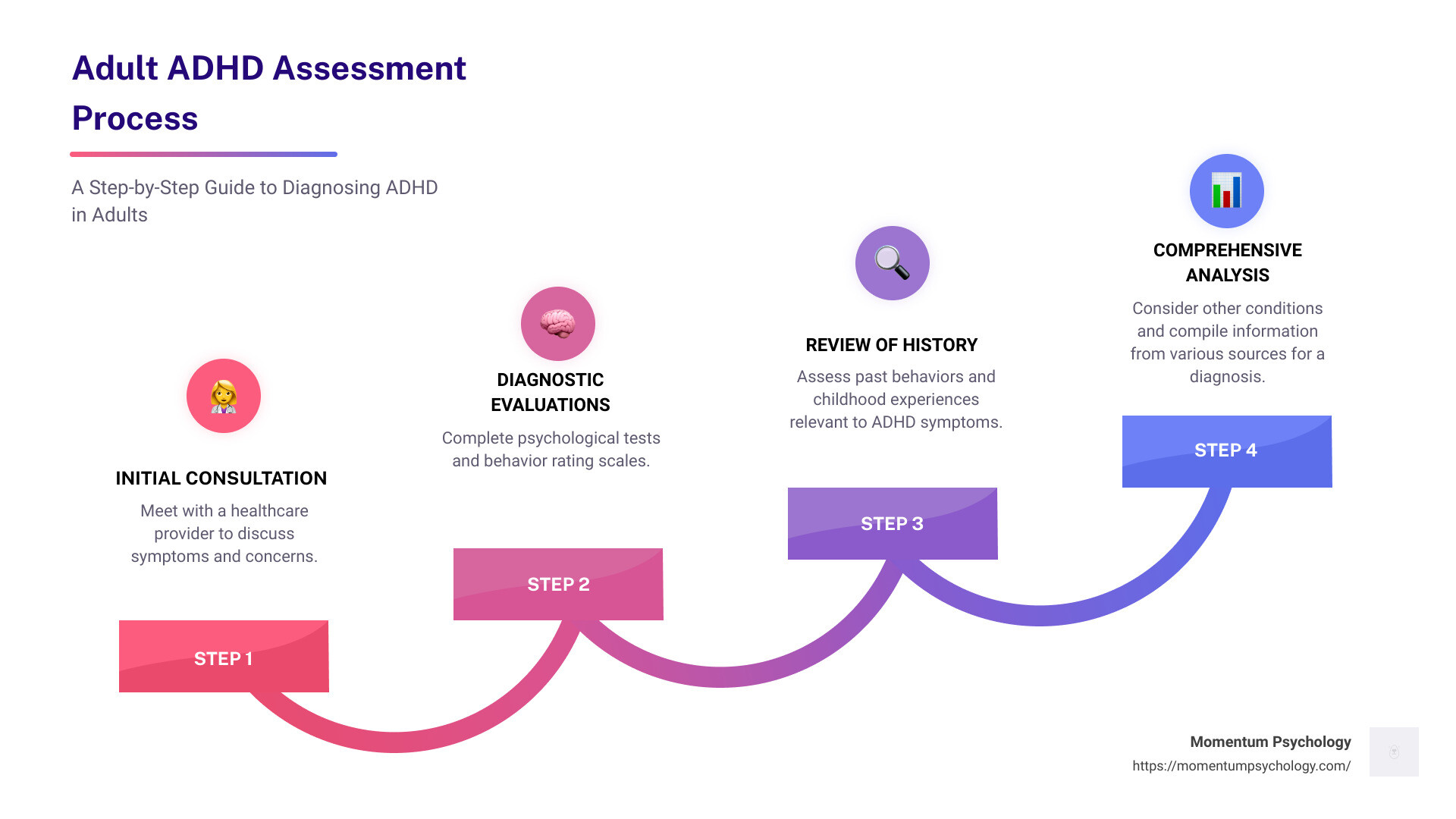
A proper adult ADHD diagnosis typically spans one to three sessions and involves multiple components. Expect a detailed clinical interview covering your current symptoms, childhood history, academic and work performance, and relationship patterns. Most evaluators use standardized rating scales and may request input from a partner or family member who can corroborate long-standing behavioral patterns. The clinician will also conduct differential diagnosis—systematically ruling out conditions like thyroid disorders, sleep apnea, anxiety, or mood disorders that mimic ADHD symptoms. Bring school reports, performance reviews, or any documentation showing a pattern over time. The more evidence you provide, the clearer the picture becomes, and the more confident both you and your provider can be in the outcome.
Building Your Framework for Ongoing ADHD Support
A diagnosis is a starting point, not a destination. The real work begins when you shift from “what’s wrong with me?” to “how do I build a life that works with my brain?” This requires moving beyond a single intervention and constructing a multi-faceted support system—one that addresses the biological, behavioral, and environmental dimensions of ADHD simultaneously. Think of it as scaffolding: no single pole holds the structure, but together they create something stable enough to build upon.
The most effective long-term ADHD management combines medical treatment with skill-building, environmental design, and social support. Medication might sharpen focus, but it won’t teach you how to prioritize tasks or repair relationship patterns formed over decades. Therapy can reframe negative self-talk, but it won’t compensate for a workspace designed to maximize distraction. Adults who thrive with ADHD typically assemble a team and toolkit rather than relying on any one solution. The key is consistency—ADHD symptoms don’t take vacations, and support systems that depend on sporadic effort tend to collapse under the weight of executive function challenges.
Developing a Personalized Treatment Plan
Your personalized treatment plan should reflect your specific symptom profile, life circumstances, and goals. For many adults, stimulant or non-stimulant medication forms the foundation, reducing core symptoms enough to make other strategies effective. Cognitive Behavioral Therapy adapted for ADHD targets the thought patterns and avoidance behaviors that accumulate over years of struggling without support. ADHD coaching fills a different niche—providing accountability, structure, and practical problem-solving for daily challenges like time management and organization. Lifestyle adjustments matter more than most people realize: consistent sleep schedules, regular exercise, protein-rich nutrition, and strategic use of body-doubling or external deadlines can meaningfully reduce symptom severity. Work with your provider to build this plan iteratively, testing interventions and adjusting based on what actually moves the needle in your daily life.
Accessing Flexible and Consistent Ongoing ADHD Support
Sustained progress depends on support that’s accessible when you need it, not just during a monthly appointment. Peer support groups—whether local or online—provide community, normalization, and practical tips from people navigating similar challenges. Digital tools like task managers with ADHD-friendly features, habit trackers, and focus apps serve as external scaffolding for executive function gaps. Regular check-ins with your prescriber or therapist, even brief ones, prevent the drift that happens when months pass between contacts. Build redundancy into your system: if one support falters, others hold. Schedule recurring appointments rather than booking reactively, automate refill reminders, and identify at least one accountability partner who understands your needs. Continuity of care isn’t a luxury for adults with ADHD—it’s the difference between sustained improvement and repeated cycles of progress followed by collapse.
Leveraging Remote Healthcare for Accessible ADHD Management
For adults with ADHD, the very symptoms that necessitate treatment often make accessing it harder. Executive function challenges turn appointment scheduling into a hurdle, long commutes drain limited focus reserves, and rigid office hours conflict with the irregular rhythms many ADHD brains operate on. Remote healthcare dissolves these barriers by bringing professional support directly into your environment—no waiting rooms, no travel time, no lost momentum between recognizing a need and acting on it. Modern telehealth platforms now offer everything from initial diagnostic assessments to ongoing medication management and therapy, all through secure digital connections. Services like Mindful have emerged to address this exact gap, providing structured remote care designed around the needs of adults managing conditions like ADHD. This shift matters particularly for adults in rural areas, those with demanding work schedules, or anyone whose previous attempts at consistent care collapsed under logistical friction. The technology has matured rapidly, with providers developing ADHD-specific remote protocols that maintain clinical rigor while dramatically improving accessibility and follow-through rates.
The Advantages of Video Consultation for Diagnosis and Therapy
Video consultation removes geography as a limiting factor, connecting you with specialists experienced in adult ADHD regardless of where you live. You attend appointments from a familiar, comfortable space—reducing the anxiety that clinical settings trigger for some people and eliminating the executive function tax of preparing to leave the house. Privacy improves too; there’s no chance of running into someone in a waiting room. For therapy sessions, video platforms enable real-time screen sharing of worksheets, visual aids, or even your actual workspace when discussing organizational strategies. Many adults report higher session attendance rates with remote healthcare simply because the activation energy required drops significantly. When the barrier between you and your provider is just opening a laptop, consistency becomes far more achievable.
Integrating Remote Care into Your Long-Term Support Strategy
Make remote care a structural element of your ongoing ADHD management rather than an occasional convenience. Schedule recurring video appointments with your prescriber at fixed intervals—monthly or quarterly—so medication adjustments happen proactively rather than after problems escalate. Use telehealth therapy sessions for CBT or coaching, alternating between video and brief phone check-ins to maintain momentum without overwhelming your calendar. Many platforms now offer asynchronous messaging with providers between sessions, perfect for quick questions about medication side effects or strategy adjustments. Pair remote clinical care with digital support tools that feed information back to your provider: mood trackers, medication logs, or productivity data that make appointments more efficient and data-driven. This integrated approach transforms ADHD management from something you chase into something woven seamlessly into your routine.
Taking the Next Step Toward Effective Adult ADHD Management
Getting an accurate adult ADHD diagnosis isn’t just about putting a name to your struggles—it’s about gaining the clarity needed to stop fighting against your brain and start working with it. The path from initial suspicion through comprehensive evaluation to long-term management is navigable when you break it into concrete steps: document your symptoms, find a specialist who takes adult ADHD seriously, complete a thorough assessment, and then build a layered support system that addresses medication, therapy, skill-building, and environment simultaneously. No single intervention carries the full weight, but a thoughtful combination creates genuine, lasting change. Remote healthcare has made this entire process more accessible than ever before, removing the logistical barriers that once kept many adults from consistent care. Whether you’re at the beginning of this journey or rebuilding after previous attempts stalled, the most important step is the next one. Reach out to a qualified provider, schedule that first appointment, and give yourself permission to pursue the support you’ve always deserved. Your brain works differently—not defectively—and with the right framework, that difference becomes manageable.