However, selecting the right industrial endoscope presents its own challenge. The market offers an overwhelming array of models spanning vastly different specifications—resolution, probe diameter, articulation range, durability ratings—each suited to different tasks. An engineer inspecting aircraft engine turbines faces entirely different requirements than one examining cast automotive parts or corroded pipeline interiors. This guide cuts through the complexity, providing a systematic framework that empowers engineers to evaluate their specific inspection demands and match them precisely to the borescope camera that will deliver reliable, actionable results.
Understanding Borescope Cameras: Types and Industrial Applications
A borescope, also known as an industrial endoscope, is an optical instrument designed to inspect areas inaccessible to the naked eye. At its core, the device consists of a camera-tipped probe, an illumination source, and a display system that together reveal the hidden interior conditions of machinery, structures, and components without requiring disassembly.
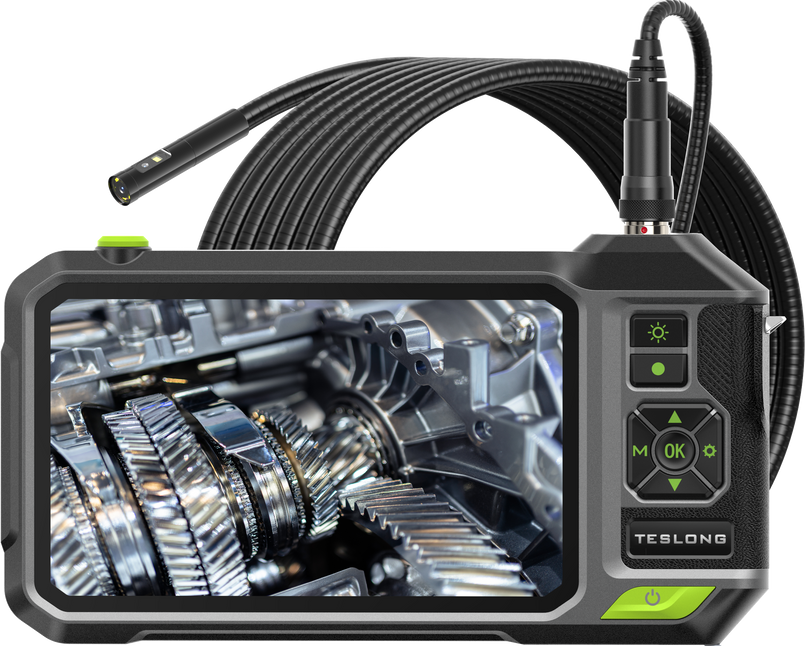 Rigid borescopes represent the simplest configuration—a straight, inflexible tube ideal for direct-line access points such as gun barrels, hydraulic cylinders, or machined bores. Their optical clarity remains excellent, but their utility is limited to straight paths. Flexible borescopes, by contrast, use fiber-optic bundles or articulating camera probes that snake through curved passages, bends, and irregular geometries found in complex assemblies. Video borescopes have emerged as the modern standard, integrating miniaturized CMOS sensors directly at the probe tip to deliver real-time digital imagery to handheld screens or connected devices, enabling immediate analysis and documentation.
Industrial applications span virtually every sector where internal integrity matters. Manufacturing quality assurance teams use borescopes to verify casting integrity, check machined surfaces, and validate weld penetration. Aerospace maintenance crews inspect turbine blades for thermal fatigue cracks between overhaul cycles. Oil and gas professionals examine pipeline corrosion and deposit buildup without costly shutdowns. Automotive engineers peer inside engine blocks and transmission housings during development and failure analysis. Each of these scenarios demands different probe characteristics, image capabilities, and durability thresholds—making the choice of borescope type the first critical decision in building an effective inspection program.
Decoding Camera Specs: The Technical Foundation for Selection
Technical specifications are not abstract numbers on a datasheet—they directly determine what defects you can detect, which spaces you can access, and how reliably your equipment performs under demanding conditions. Understanding these specs transforms the selection process from guesswork into informed engineering decision-making.
Resolution and Image Quality: The Core of Detail
The image sensor is the eye of any borescope, and modern units rely almost exclusively on CMOS sensors due to their compact size, low power consumption, and strong performance in miniaturized applications. Resolution defines the level of detail captured: a 720p sensor may suffice for general cavity checks, but identifying hairline cracks or pitting corrosion typically demands 1080p or higher. Units offering 4K resolution provide extraordinary detail for critical aerospace or precision manufacturing inspections where sub-millimeter defects carry serious consequences. Frame rate matters when inspecting moving components or sweeping through long passages quickly—anything below 30 fps can produce motion blur that obscures defects. Low-light performance also warrants attention, as deeper cavities and narrow passages challenge even well-lit probes, making sensors with good signal-to-noise ratios essential for clean imagery in dim conditions.
Probe Dimensions and Articulation: Access and Maneuverability
Probe diameter determines which openings you can physically enter. Diameters range from ultra-thin options under 4mm—necessary for small-bore tubing or intricate cast passages—up to larger probes that sacrifice access for superior image quality and illumination. Probe length must match or exceed the depth of your inspection target, with options spanning from under one meter to ten meters or more for extended pipeline work. Articulation capability defines how well the camera tip navigates bends and directs its view. Two-way articulation handles simple curves, while four-way articulation with 180-degree or greater bending angles enables navigation through complex geometries like turbine interiors or multi-bend exhaust manifolds.
Lighting and Durability: Environmental Performance
Illumination comes from LEDs positioned around the camera tip, and their brightness, color temperature, and arrangement directly affect image clarity. Adjustable intensity prevents washout on reflective metal surfaces while ensuring adequate illumination in dark cavities. Multiple LED configurations provide more uniform lighting with fewer shadows. Durability ratings follow the IP (Ingress Protection) scale—IP67 probes withstand temporary submersion, making them suitable for wet environments, while IP68 units handle continuous underwater operation. The probe sheath material matters equally: tungsten-braided or stainless steel outer layers resist abrasion when navigating rough internal surfaces, and chemical-resistant coatings protect against corrosive environments encountered in petrochemical or wastewater applications.
Matching Camera Capabilities to Your Inspection Needs
Specifications only matter when they solve a real problem. The key to effective selection lies in working backward—starting from your inspection challenge and identifying which technical capabilities address it directly. The following scenarios illustrate how different priorities emerge depending on what you need to find, where you need to look, and what conditions you’ll face.
For Detailed Visual Inspection and Defect Analysis
When the primary goal is identifying subtle surface anomalies—hairline cracks in turbine blades, early-stage pitting corrosion inside heat exchangers, or incomplete weld fusion—image quality becomes the non-negotiable priority. A high-resolution inspection camera delivering 1080p or 4K output captures the fine detail necessary to distinguish a genuine defect from a surface blemish or shadow artifact. Pair this with adjustable LED illumination that prevents glare on polished metal surfaces while still revealing shallow surface irregularities through controlled shadow contrast. For crack detection work, look for units offering image capture and zoom functionality so that inspectors can document findings at full resolution and magnify suspect areas during post-inspection review. Color accuracy also matters here, as corrosion assessment relies on distinguishing between oxide colorations that indicate different degradation stages.
For Inspections in Confined or Complex Spaces
Accessing the interior of a turbocharger housing, navigating through multi-bend cooling channels, or threading through narrow cast passages demands a fundamentally different priority set. Here, probe diameter and articulation range dominate the decision. Ultra-thin probes below 4mm diameter open access to spaces that larger units simply cannot enter, while four-way articulation with bending angles exceeding 180 degrees allows the camera tip to look back on itself—essential when inspecting behind obstructions or around tight radius bends. Flexible probe construction must balance softness for navigability with sufficient rigidity to push through longer passages without buckling. Engineers working inside complex machinery should also consider insertion tube length carefully, ensuring it reaches the deepest inspection points without requiring probe extensions that reduce articulation responsiveness.
For Challenging Environments (Wet, Hot, Corrosive)
Inspection environments are rarely clean and comfortable. Submerged pipeline interiors, steam-exposed turbine casings, and chemical processing vessels each impose harsh conditions that will quickly destroy inadequately protected equipment. For wet or submerged applications, an IP68-rated probe capable of sustained immersion is essential—not merely splash resistance. High-temperature environments require probes with heat-tolerant tip assemblies and sheaths rated for the expected thermal exposure. In petrochemical or wastewater settings, chemical-resistant coatings and corrosion-proof materials like tungsten-braided sheaths prevent degradation from acidic or alkaline exposure. Selecting for durability in these scenarios is not about over-engineering—it’s about ensuring the tool survives long enough to deliver consistent, reliable inspection data across its operational lifespan.
A Step-by-Step Guide to Selecting the Best Inspection Tools
Having established the relationship between specifications and applications, the next challenge is organizing your decision-making into a repeatable, efficient process. Rather than browsing catalogs and reacting to marketing claims, work through these four steps to arrive at a well-justified selection that serves your actual operational requirements.
Step 1: Define Your Primary Inspection Task and Environment
Before evaluating any equipment, answer these fundamental questions: What is the smallest defect you need to reliably detect—a 0.1mm crack, visible corrosion pitting, or general structural deformation? What is the smallest access point you must pass through, and how deep must the probe reach? What environmental conditions will the probe encounter—ambient temperature ranges, presence of water or chemical fluids, abrasive internal surfaces? Finally, how frequently will inspections occur, and will the tool be used by a single specialist or rotated among multiple technicians? Documenting these answers creates a concrete requirements profile that eliminates subjective preferences from the process.
Step 2: Prioritize Key Technical Specifications
Your answers from Step 1 naturally create a hierarchy of importance. If your smallest target defect demands extreme detail, resolution and lighting quality rank highest. If access geometry is the primary constraint, probe diameter and articulation take precedence over pixel count. Build a simple priority matrix: rank resolution, probe dimensions, articulation range, durability rating, and working length from most to least critical for your application. This prevents the common mistake of selecting a high-resolution unit that physically cannot reach the inspection target, or choosing an ultra-flexible probe that lacks the image quality to identify the defects you’re hunting.
Step 3: Evaluate Usability and Integration Factors
Beyond core optical and mechanical specs, practical workflow considerations influence long-term satisfaction. Software capabilities such as on-screen measurement tools, annotation features, and standardized reporting formats streamline documentation and reduce post-inspection processing time. Portability matters for field work—consider total system weight, case design, and whether the unit operates as a standalone handheld device or requires external monitors. Battery life should comfortably exceed your typical inspection duration with margin for extended sessions. Data connectivity options including USB export, Wi-Fi streaming, and compatibility with your existing asset management systems determine how smoothly inspection data flows into maintenance decision-making workflows.
Step 4: Compare Brands and Models Against Your Criteria
With your prioritized requirements and usability preferences defined, narrow the field to two or three candidate models that meet your non-negotiable specifications. Manufacturers like Teslong offer a range of borescope models spanning different probe diameters, resolutions, and articulation capabilities, making it worthwhile to compare options within a single brand’s lineup as well as across competitors. Create a side-by-side comparison using your priority matrix, scoring each model against your ranked criteria rather than relying on overall feature counts or brand reputation alone. Request demonstration units whenever possible—real-world handling reveals ergonomic issues, image quality nuances, and articulation responsiveness that spec sheets cannot convey. Consult peer reviews from engineers in similar applications, and verify warranty terms and service support availability in your region before committing.
Turning Your Selection Framework Into Confident Equipment Decisions
Selecting the right borescope camera is not a matter of choosing the most expensive model or the one with the longest feature list—it is a systematic process of aligning technical capabilities with the specific demands of your inspection environment. The framework presented here distills that process into manageable steps: define what you need to find and where you need to find it, prioritize the specifications that directly serve those requirements, evaluate practical workflow factors, and then compare shortlisted models against your established criteria rather than marketing narratives.
By approaching the decision this way, engineers eliminate the risk of investing in equipment that excels on paper but fails in practice—whether because a high-resolution probe cannot physically reach the target area, or a perfectly sized unit lacks the image quality to reveal critical defects. The right industrial endoscope, properly matched to your operational reality, becomes far more than a diagnostic tool. It becomes an investment in predictive maintenance capability, operational safety, and the kind of evidence-based decision-making that prevents unplanned downtime and extends asset life. Use this framework with confidence, and let your inspection challenges—not spec sheet comparisons—drive every selection decision you make.