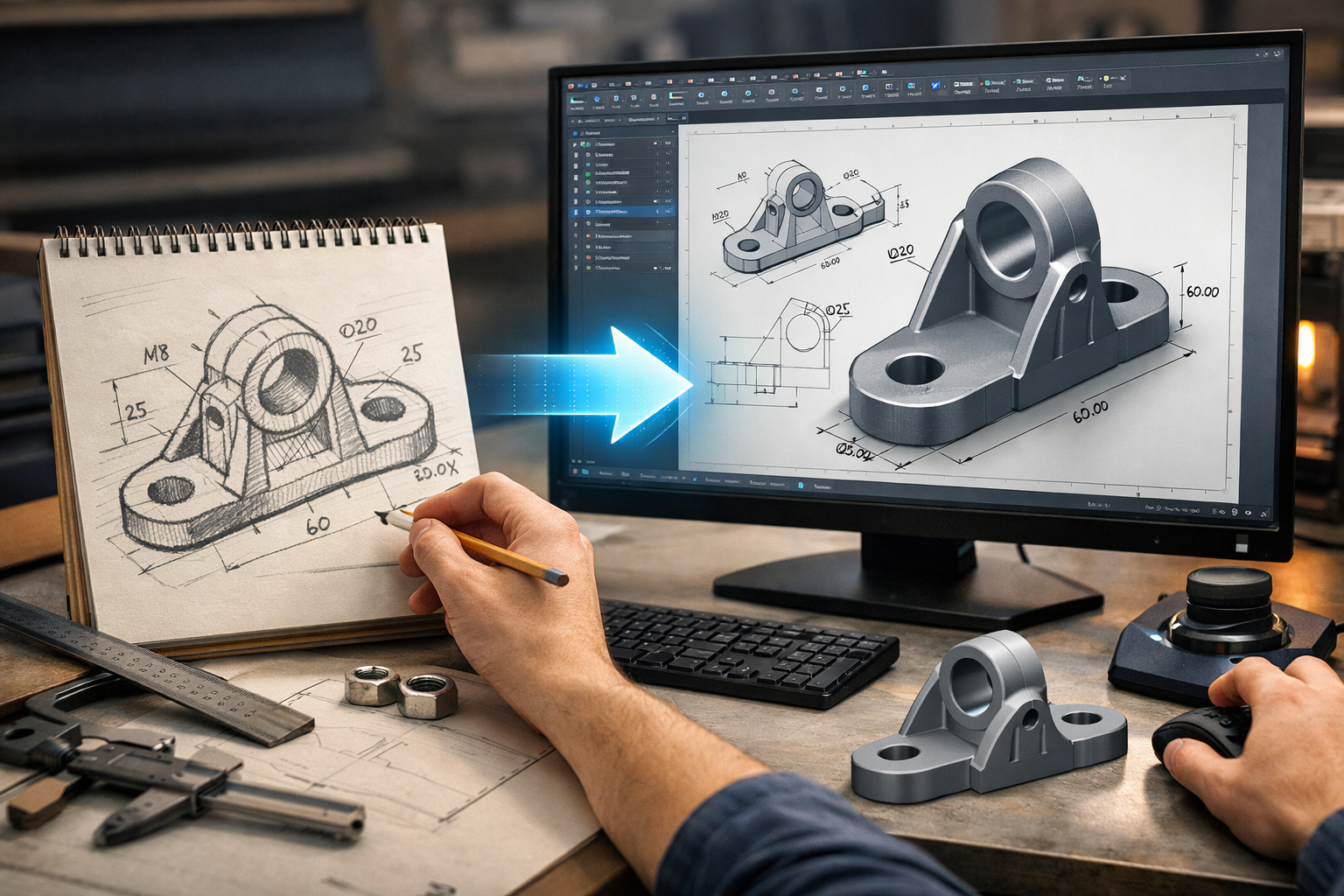
Hand sketches are still where many great mechanical ideas begin. Whether it’s a concept drawn on a notepad, a scanned whiteboard sketch, or a rough layout shared during a design meeting, these early visuals often carry the core intent of a product. However, turning a hand sketch into a production-ready mechanical CAD drawing is where true engineering value is created.
In 2026, manufacturers, startups, and engineering teams across the USA and UK are increasingly relying on mechanical CAD design services to bridge the gap between creative concepts and manufacturable reality. With rising expectations for accuracy, speed, and digital collaboration, the conversion process has become more structured, data-driven, and technology-assisted than ever before.
This guide explains how hand sketches are transformed into precise 2D and 3D mechanical CAD drawings, the challenges involved, and why this process is a critical step in modern mechanical product development.
Why Are Hand Sketches Still Important in Mechanical Engineering?
Despite advancements in CAD software and AI-assisted modeling, hand sketches remain valuable because they:
- Enable rapid ideation without software constraints
- Capture functional intent early in the design process
- Encourage creativity during brainstorming sessions
- Help communicate concepts quickly to non-technical stakeholders
According to a study by Autodesk Design & Make Report, over 65% of engineers still begin early-stage design with hand sketches before moving into CAD workflows. This hybrid approach is especially common in mechanical product design services, where form, function, and manufacturability must align.
What Does “Production-Ready” Mean in Mechanical CAD Drawings?
A production-ready mechanical CAD drawing is far more than a clean digital version of a sketch. It must be suitable for:
- Manufacturing
- Assembly
- Quality control
- Vendor communication
This includes:
- Accurate dimensions and tolerances
- Material specifications
- GD&T annotations
- Assembly relationships
- Compliance with ASME (USA) or BS/ISO (UK) standards
Without these elements, even the most detailed sketch cannot move forward to fabrication.
Step-by-Step: How Are Hand Sketches Converted into Mechanical CAD Drawings?
1. How Is the Hand Sketch Digitized and Interpreted?
The process begins by converting physical sketches into digital references:
- Scanning paper sketches
- Photographing whiteboard drawings
- Collecting annotated PDFs or images
At this stage, CAD professionals analyze:
- Design intent
- Functional relationships
- Missing dimensions or unclear geometry
This interpretation step is crucial, as sketches often lack scale or precision.
2. How Are Design Requirements Clarified Before CAD Modeling?
Before any modeling begins, mechanical designers typically confirm:
- Operating conditions
- Load requirements
- Material preferences
- Manufacturing method (CNC, sheet metal, casting, 3D printing)
In the USA and UK, regulatory expectations and supply chain constraints are also reviewed early to avoid redesigns later.
This collaborative validation is a growing trend in mechanical CAD design services, reducing rework by up to 30%, according to McKinsey’s Engineering Productivity Report.
3. How Is 2D CAD Drafting Created from Hand Sketches?
Once requirements are clear, engineers create precise 2D drawings using CAD platforms such as AutoCAD Mechanical.
This stage includes:
- Orthographic views (top, front, side)
- Section and detail views
- Datum references
- Tolerances and notes
Many manufacturers still rely on 3D AutoCAD Mechanical Drawings supported by accurate 2D documentation for shop-floor execution.
4. When and Why Is 3D Mechanical Modeling Introduced?
Modern workflows rarely stop at 2D. 3D modeling allows engineers to:
- Visualize complex geometries
- Identify interferences early
- Simulate assembly and motion
- Validate design feasibility
3D drawing mechanical engineering workflows are now standard across automotive, industrial machinery, and consumer product sectors in both the USA and UK.
According to Statista, over 78% of mechanical engineering firms in North America use 3D CAD as their primary design format, driven by faster prototyping and digital manufacturing integration.
5. How Are Materials and Manufacturing Constraints Applied?
A sketch may show what a product looks like, but CAD modeling defines how it will be made.
At this stage, designers incorporate:
- Material thickness rules
- Standard fasteners
- Machining allowances
- Draft angles for molded parts
This step is especially critical in mechanical product design services, where cost efficiency and manufacturability directly impact market success.
6. How Are Tolerances and GD&T Added for Production Accuracy?
Production-ready drawings must communicate acceptable variation.
Engineers apply:
- Linear and angular tolerances
- Geometric Dimensioning & Tolerancing (GD&T)
- Surface finish symbols
In the USA, ASME Y14.5 standards dominate, while UK manufacturers often follow ISO GPS standards. CAD professionals experienced in both regions ensure drawings meet supplier expectations globally.
7. How Is Quality Checked Before Final Release?
Before submission to manufacturing, drawings undergo rigorous checks:
- Dimension verification
- Assembly fit validation
- Standard compliance review
- Version control
Many engineering teams now use digital checklists and AI-assisted validation tools, a growing trend in advanced mechanical CAD design services.
What Are the Common Challenges When Converting Hand Sketches to CAD?
Ambiguous Design Intent
Sketches often lack clarity, leading to assumptions that must be validated.
Missing Dimensions
Engineers must infer or calculate sizes based on functional requirements.
Over-Design Risks
Early concepts may not account for manufacturing limitations.
Communication Gaps
Designers, engineers, and stakeholders may interpret sketches differently.
Addressing these challenges early is key to avoiding costly revisions later.
What Are the Latest Trends in Mechanical CAD Conversion (2026)?
AI-Assisted Sketch Recognition
Modern CAD tools can now recognize hand-drawn shapes and suggest parametric geometry, reducing modeling time.
Cloud-Based Collaboration
Remote teams across the USA and UK collaborate in real time, accelerating approvals.
Digital Twin Integration
CAD models increasingly serve as the foundation for simulation and lifecycle management.
Sustainability-Driven Design
Material optimization and lightweighting are prioritized during CAD conversion.
According to Deloitte’s Manufacturing Outlook, companies using advanced CAD workflows reduce time-to-market by up to 25%.
Why Are Businesses Outsourcing Mechanical CAD Conversion?
Startups and manufacturers increasingly outsource because:
- Skilled CAD engineers are costly to hire in-house
- Projects require scalable resources
- Global suppliers expect standardized drawings
Outsourced mechanical CAD design services provide access to specialized expertise without long-term overheads.
Who Benefits Most from Converting Hand Sketches to CAD?
This process is essential for:
- Product startups validating prototypes
- Architects coordinating mechanical components
- Manufacturers preparing shop drawings
- Engineers standardizing legacy designs
Accurate CAD drawings serve as the single source of truth throughout the product lifecycle.
Final Thoughts:
Hand sketches represent creativity, but production-ready mechanical CAD drawings represent execution. In today’s competitive engineering landscape, especially across the USA and UK, businesses that master this transition gain speed, accuracy, and confidence in their designs.
With evolving tools, AI-driven workflows, and global collaboration, converting sketches into precise 3D AutoCAD Mechanical Drawings is no longer just a drafting task, it’s a strategic advantage.
For companies seeking reliability and standards-driven execution, partnering with an experienced UK-based CAD design company can help ensure that every sketch evolves into a manufacturable, compliant, and future-ready mechanical design.
FAQs
How do you convert hand sketches into mechanical CAD drawings?
Hand sketches are converted into mechanical CAD drawings by digitizing the sketch, defining design intent, creating precise 2D layouts, and developing accurate 3D models using professional mechanical CAD design services. The process also includes applying tolerances, materials, and manufacturing constraints to make the drawings production-ready.
Which software is best for converting hand sketches to mechanical CAD?
AutoCAD Mechanical, SolidWorks, and Fusion 360 are commonly used for converting hand sketches into CAD drawings. For industrial projects, AutoCAD Mechanical is widely preferred for creating detailed 3D AutoCAD Mechanical Drawings that meet US and UK manufacturing standards.
What is the difference between a hand sketch and a production-ready CAD drawing?
A hand sketch is a conceptual visual, while a production-ready CAD drawing includes accurate dimensions, tolerances, material specifications, and compliance with manufacturing standards. CAD drawings are essential for fabrication, assembly, and quality control in mechanical engineering.
Why is 3D mechanical CAD modeling important in manufacturing?
3D drawing mechanical engineering workflows help engineers visualize assemblies, detect design clashes, simulate motion, and validate manufacturability before production. This reduces errors, rework, and manufacturing costs, especially for complex mechanical components.
Can hand-drawn sketches be used for mechanical product design?
Yes, hand-drawn sketches are often the starting point for mechanical product design services. These sketches capture design intent and functionality, which are then converted into detailed CAD models suitable for prototyping, testing, and mass production.
How long does it take to convert a hand sketch into a CAD drawing?
The timeline depends on design complexity. Simple mechanical parts may take 1–2 days, while complex assemblies with 3D modeling, tolerances, and compliance checks may take several days. Professional mechanical CAD design services help speed up the process without compromising accuracy.
Why do companies in the USA and UK outsource mechanical CAD conversion?
Companies in the USA and UK outsource mechanical CAD conversion to reduce costs, access skilled CAD engineers, and ensure drawings comply with ASME and ISO standards. Outsourcing also allows faster turnaround and scalability for growing engineering projects.
Are mechanical CAD drawings required for manufacturing approval?
Yes, manufacturers require detailed mechanical CAD drawings with dimensions, tolerances, and material details before approving production. These drawings serve as the official reference for machining, fabrication, and quality inspections.
What standards are followed in mechanical CAD drawings?
Mechanical CAD drawings typically follow ASME Y14.5 standards in the USA and ISO/BS standards in the UK. Professional CAD services ensure drawings meet these standards for global manufacturing compatibility.
How do mechanical CAD design services improve product development?
Mechanical CAD design services streamline product development by transforming concepts into accurate digital models, reducing design errors, improving collaboration, and accelerating time-to-market for mechanical products.

Backlinks Hub is a results-driven SEO platform focused on smart link-building, valuable content, and proven strategies that help brands grow faster and rank higher in search engines.