Pet ownership continues to rise globally, and with it, the demand for reliable identification systems that improve lost-pet recovery rates, regulatory compliance, and animal welfare. While traditional engraved ID tags remain common, RFID-based pet identification has become the industry standard in veterinary medicine, shelters, and breeding operations.
This article explores the technology behind RFID pet tags and microchips, how they work under international standards, implementation considerations, and why manufacturers such as XIUCHENG RFID play a critical role in global supply chains.
1. What Is an RFID Pet Tag?
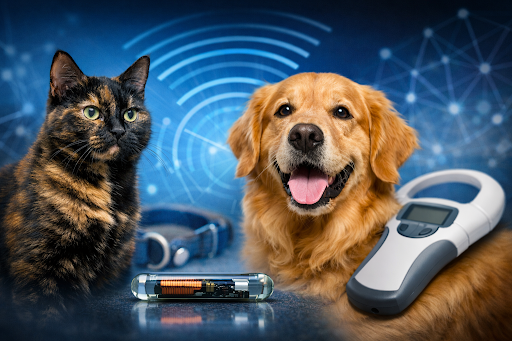
An RFID pet identification system typically consists of:
-
A passive RFID microchip (transponder)
-
A handheld or fixed RFID reader (scanner)
-
A backend registration database
Most companion animals—especially dogs and cats—are implanted with a passive low-frequency (LF) RFID microchip operating at 134.2 kHz, compliant with ISO standards.
Unlike GPS trackers, RFID pet microchips:
-
Do not require batteries
-
Do not transmit continuously
-
Are activated only when scanned
-
Are designed for lifetime functionality
This makes them maintenance-free and highly durable.
2. International Standards Governing Pet RFID
Pet microchips are primarily governed by:
-
ISO 11784 – Structure of identification code
-
ISO 11785 – Air interface protocol
These standards define:
-
15-digit unique ID numbers
-
FDX-B (Full Duplex) communication protocol
-
Compatibility across compliant readers worldwide
Countries in the European Union, Australia, and many parts of Asia legally require ISO 11784/11785 compliant chips for pet travel and registration.
In the United States, non-ISO legacy frequencies (125 kHz and 128 kHz) previously created interoperability issues, but ISO-compliant 134.2 kHz chips are now dominant.
3. How RFID Pet Microchips Work
An RFID pet microchip contains:
-
A silicon integrated circuit (IC)
-
A copper coil antenna
-
Biocompatible glass encapsulation
-
An anti-migration coating (often polypropylene)
When a scanner emits a low-frequency electromagnetic field:
-
The tag antenna captures energy.
-
The IC powers up via inductive coupling.
-
The chip transmits its unique identification number.
-
The reader decodes and displays the ID.
There is no GPS, no internal power source, and no data transmission beyond a few centimeters.
4. Why RFID Is the Industry Standard
4.1 Lifetime Durability
Passive LF RFID microchips are designed to last the lifetime of the animal. With no battery degradation risk, failure rates are extremely low when manufactured under proper quality controls.
4.2 Global Compatibility
ISO-compliant chips can be read by scanners used by:
-
Veterinary clinics
-
Animal shelters
-
Customs authorities
-
Breeders
-
Livestock inspectors
4.3 Improved Recovery Rates
Studies across Europe and North America consistently show that microchipped dogs are significantly more likely to be returned to owners compared to non-microchipped pets.
The microchip itself does not store owner data; instead, it stores a unique ID linked to a registration database.
5. Microchip vs. External RFID Pet Tag
It is important to distinguish between:
Injectable Microchips
-
Implanted subcutaneously
-
Permanent
-
Tamper-resistant
-
Invisible
External RFID Pet Tags
-
Attached to collars
-
Larger read range
-
Easier replacement
-
May incorporate UHF technology
External RFID tags are often used in:
-
Kennels
-
Breeding facilities
-
Research labs
-
Livestock management
For consumer pet identification, injectable LF chips remain the global standard.
6. Manufacturing Considerations for RFID Pet Microchips
High-quality RFID pet tags require strict control across several dimensions:
✔ Biocompatible Glass Encapsulation
Prevents body fluid ingress and ensures tissue compatibility.
✔ Anti-Migration Coating
Reduces post-implant movement.
✔ Hermetic Sealing
Prevents corrosion or internal short circuits.
✔ ISO Frequency Tuning
Ensures compliance with 134.2 kHz standards.
✔ Sterilization Process
Typically via ethylene oxide (EtO) to maintain implant safety.
Manufacturers such as XIUCHENG RFID focus on producing ISO 11784/11785 FDX-B compliant animal microchips under controlled production environments to meet veterinary and export requirements.
7. Common Concerns About RFID Pet Microchips
7.1 Are They Safe?
Extensive global use over decades has demonstrated a strong safety profile. Complications are rare and usually related to improper implantation rather than chip malfunction.
7.2 Can They Be Tracked?
No. Standard RFID pet microchips:
-
Cannot be tracked in real time
-
Have extremely short read ranges
-
Require proximity scanning
They are identification devices—not tracking systems.
7.3 Can They Fail?
Failure rates are statistically very low when chips are manufactured under strict quality assurance. Reputable suppliers conduct:
-
Frequency testing
-
Encapsulation inspection
-
Signal strength validation
-
Sterility verification
8. Regulatory and Travel Requirements
Many countries require microchipping for:
-
International pet travel
-
Rabies vaccination certification
-
Breeding registration
-
Shelter intake processing
For example:
-
EU Pet Travel Scheme requires ISO-compliant chips
-
Australia mandates microchipping before registration
-
Increasing U.S. municipalities require microchipping for adoption
Compliance with ISO standards is therefore not optional in global trade environments.
9. Beyond Companion Animals: Livestock Applications
RFID animal identification extends beyond pets into:
-
Cattle traceability programs
-
Sheep and goat tagging
-
Swine identification
-
Animal health monitoring
In livestock, RFID supports:
-
Disease control
-
Supply chain traceability
-
Regulatory compliance
-
Export certification
The technology principles are similar, but packaging formats differ (ear tags, boluses, injectable transponders).
10. Selecting the Right RFID Pet Tag Supplier
Procurement managers and veterinary distributors should evaluate:
✔ ISO Certification Documentation
✔ Production Capacity and Lead Time
✔ Quality Control Protocols
✔ Custom Branding Options
✔ Regulatory Export Support
Reliable suppliers provide technical documentation, compliance certificates, and batch traceability.
11. Future Trends in RFID Animal Identification
Emerging developments include:
-
Integrated temperature-sensing microchips
-
Encrypted authentication features
-
Enhanced database interoperability
-
Combined NFC + RFID dual-technology tags
As IoT infrastructure expands, animal identification systems may increasingly integrate with digital veterinary records and smart shelter management systems.
Conclusion
RFID pet tags and microchips have become foundational to modern animal identification systems worldwide. Their reliability, global interoperability, and compliance with ISO standards make them indispensable in veterinary medicine, animal welfare, and regulatory frameworks.
For distributors, clinics, and importers, selecting a compliant and quality-focused manufacturing partner is essential to ensure safety, performance, and long-term reliability.
As pet ownership continues to grow globally, RFID technology will remain central to responsible animal management and recovery systems.

“Sajjad Hassan, CEO of Grow SEO Agency, contributes to 500+ high-demand websites. For tailored SEO solutions, I’m here to elevate your online presence and drive results.”